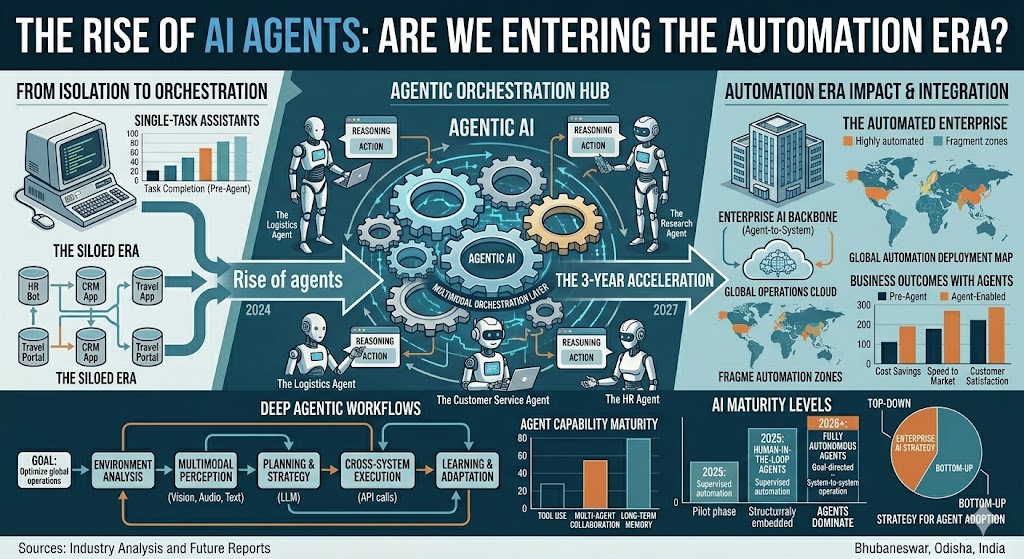
AI agents are transforming software from passive tools into active digital workers capable of planning, reasoning, and executing tasks with minimal human input. Unlike traditional automation, these systems can break down goals, use tools, and adapt dynamically, making them closer to autonomous coworkers than simple assistants.
Driven by advances in large language models, tool integration, and multi-agent systems, AI agents are rapidly being adopted in areas like software development, customer support, marketing, and business operations. Many organizations are shifting toward “agent ecosystems,” where multiple specialized AI systems collaborate to complete complex workflows.
While this shift promises major gains in productivity, speed, and cost efficiency, it also introduces risks such as security concerns, reliability issues, and governance challenges.
Overall, AI agents signal a new automation era where humans set objectives and AI systems increasingly handle execution and decision-making.


7
Introduction: From Tools to Digital Workers
For decades, software has been built around a simple idea: humans operate tools. You click, type, configure, and execute tasks step by step. But in 2026, that model is rapidly shifting.
We are entering an era where software doesn’t just respond—it acts. These systems, known as AI agents, are capable of planning, reasoning, and executing multi-step tasks with minimal human direction. Unlike traditional automation scripts or chatbots, AI agents behave more like digital coworkers than tools.
Recent industry analyses show that organizations are moving from simple copilots to fully autonomous workflows, where multiple agents collaborate to complete business processes end-to-end . This shift is not just incremental—it represents a structural change in how digital work gets done.
So the real question is no longer “What can AI do?” but rather “What happens when AI starts doing the work itself?”
What Exactly Are AI Agents?


8
At a basic level, an AI agent is a system that uses artificial intelligence to pursue a goal by:
- Understanding an objective
- Breaking it into steps
- Using tools (apps, APIs, databases, browsers)
- Adapting based on feedback
Unlike a traditional chatbot, which answers questions, an AI agent takes action.
Think of the difference like this:
- A chatbot is a librarian who tells you where books are
- An AI agent is a librarian who finds the books, summarizes them, and emails you a report
Modern agentic systems often include:
- Memory (to remember past actions)
- Planning (to decide what to do next)
- Tool use (to interact with external systems)
- Collaboration (multiple agents working together)
This architecture is part of a broader shift called agentic AI, where systems behave as autonomous entities capable of reasoning and acting in dynamic environments .
Why AI Agents Are Emerging Now


7
AI agents didn’t appear overnight. They are the result of several converging breakthroughs:
1. Better reasoning models
Modern large language models can now handle multi-step reasoning, allowing them to plan rather than just respond.
2. Tool integration
Agents can now connect to real systems—emails, CRMs, APIs, codebases—making them operational, not just conversational.
3. Orchestration frameworks
Instead of one AI doing everything, multiple specialized agents now collaborate, similar to human teams. In production environments, multi-agent systems are becoming the default design pattern .
4. Demand for automation
Businesses are under pressure to reduce costs and increase speed. AI agents offer a way to automate not just tasks, but entire workflows.
Together, these advances have pushed AI from “assistant” status into “operator” territory.
The Automation Era: What’s Actually Changing


7
The rise of AI agents is not just a technical upgrade—it’s reshaping how organizations are structured.
1. From tasks to outcomes
Instead of assigning tasks like “write email” or “analyze data,” humans now assign outcomes like:
“Increase customer retention by 10% this quarter.”
Agents then decide how to achieve it.
2. From teams to “AI-augmented pods”
Companies are reorganizing into small teams supported by AI agents. Some experimental structures now combine 1–5 humans with multiple agents handling execution, testing, and analysis .
3. From linear workflows to agent ecosystems
Work is no longer a chain—it’s a network. Multiple agents specialize in different roles:
- Research agents gather information
- Planning agents design strategies
- Execution agents perform tasks
- Monitoring agents track performance
These ecosystems coordinate continuously, often without direct human intervention.
4. From human labor to human oversight
Humans are shifting from “doers” to supervisors of automated systems.
A growing number of executives are already deploying personal AI “chief-of-staff” agents to manage calendars, emails, and decisions .
Real-World Use Cases Already Emerging


7
AI agents are already moving beyond experiments into production systems.
1. Software development
Agents can now:
- Write code
- Fix bugs
- Run tests
- Suggest architecture changes
Some studies show agents contributing directly to CI/CD workflows in real repositories with measurable success rates .
2. Customer support
Instead of scripted bots, agents can:
- Understand complex issues
- Access customer history
- Take actions (refunds, ticket resolution)
3. Marketing automation
Multi-agent systems can:
- Research markets
- Generate campaigns
- Test performance
- Optimize ads automatically
4. Business operations
Agents increasingly handle:
- Scheduling
- Reporting
- Supply chain tracking
- Internal knowledge queries
These systems are especially powerful when connected across enterprise data systems.
The Multi-Agent Revolution
One of the most important shifts is the move from single agents to teams of agents.
Instead of one AI doing everything, organizations now deploy:
- Specialist agents (finance, marketing, engineering)
- Coordination agents (task routing)
- Evaluation agents (quality control)
In fact, many production deployments already use multiple collaborating agents as standard practice .
This mirrors human organizations—but at machine speed.
Opportunities and Risks


7
Opportunities
- Massive productivity gains
- Lower operational costs
- Faster innovation cycles
- Democratization of software creation
- Small teams achieving enterprise-level output
Risks
However, challenges are real:
- Loss of control: Agents acting beyond intended scope
- Security risks: Prompt injection and data leakage
- Reliability issues: Hallucinations in decision-making
- Governance gaps: Difficulty auditing autonomous actions
Research highlights ongoing concerns like hallucination in action, infinite loops, and system-level unpredictability in autonomous workflows .
The Future: What Comes Next?


7
The next phase of AI agents is likely to include:
1. Fully autonomous workflows
Entire business processes—from lead generation to delivery—may run with minimal human input.
2. Agent marketplaces
Companies will likely “hire” specialized AI agents like employees.
3. Personal AI operating systems
Each individual may have a suite of agents managing life tasks, from scheduling to finances.
4. Cross-agent economies
Agents may begin negotiating, coordinating, and transacting with other agents on behalf of humans.
Industry projections suggest that a large portion of enterprise applications will embed AI agents within the next few years .
Conclusion: Are We Entering the Automation Era?
Yes—but not in the way early automation once replaced manual labor.
This time, automation is expanding into thinking work: planning, reasoning, coordination, and decision-making.
AI agents are not replacing humans outright. Instead, they are redefining roles:
- Humans define goals
- Agents execute workflows
- Systems self-optimize in real time
We are moving toward a world where organizations are less like hierarchies of people and more like ecosystems of humans and intelligent agents working together.
The automation era isn’t coming.
It has already started.